Wednesday, 28 January 2015

Sharp Tools, Dull Minds & Thinking Magic

I was reading Nicholas Carr's The Glass Cage: Automation and Us when I came across this passage:
"Modern [applications] are getting 'helpful' enough that at times I feel like an [application] operator than a programmer," writes Vivek Haldar, a veteran software developer with Google. "The behavior all these tools encourage is not 'think deeply about your code and write it carefully,' but 'just write a crappy first draft of your code, and then the tools will tell you not just what's wrong with it, but also how to make it better" (78).
Like the programming tools mentioned above, "applications automate many tricky and time-consuming chores" (78). Even though I know how to create a reference from scratch, I used BibMe.org  to create the following citation:

 Carr, Nicholas. The Glass Cage: Automation and Us. New York: W.W. Norton, 2014. Print. 

Why not? It's easier and I don't have to waste time on the nit-picky stuff. Haldar draws this "verdict: 'Sharp tools, dull minds'" (78).


I remember hearing how calculators would make us lazy when I was a tot in school. But we wouldn't take back the calculator from education these days, would we? Students are now free to move onto more practical applications of mathematics since calculators have liberated them from memorizing times tables.

But reading Nicholas Carr's book reminded me of the time, early one morning, a student asked me, "When will the library open?"

I replied, "In five minutes."

For some reason, the student then asked, "How many seconds is that?"

I paused for a moment and then said, "300."

The student was shocked: "How did you do that? How did you calculate that in your head?"

Magic.


Image credits:
Artificial intelligence. Photograph. Encyclopædia Britannica ImageQuest. Web. 28 Jan 2015. 
http://quest.eb.com/#/search/107_295715/1/107_295715/cite

Magicians at the Carnival in Berlin, 1836 . Fine Art. Encyclopædia Britannica ImageQuest. Web. 28 Jan 2015. 
http://quest.eb.com/#/search/108_277187/1/108_277187/cite

Monday, 26 January 2015

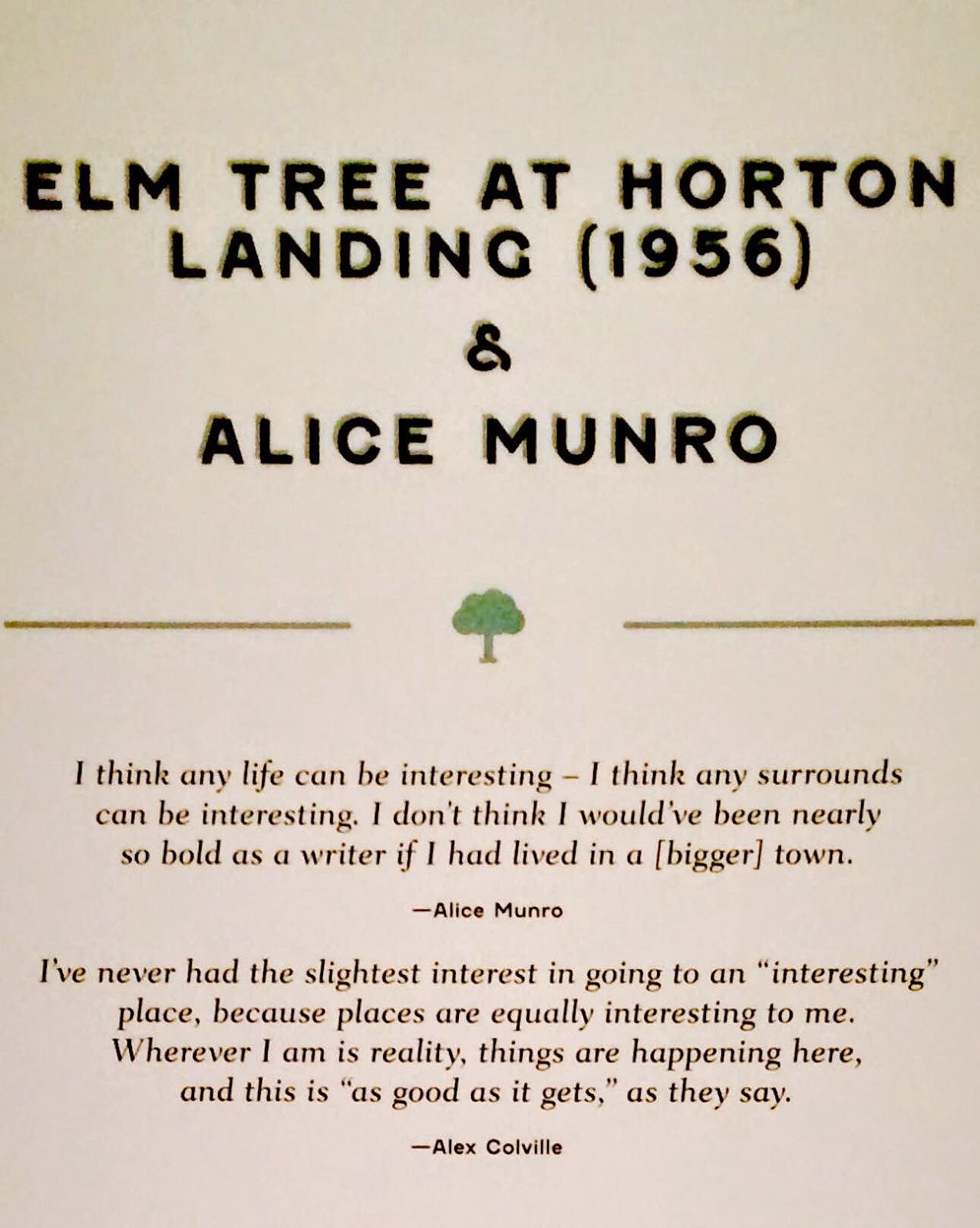
As Good as It Gets

Why travel?


Picture taken at the AGO's Alex Colville exhibition December 30, 2014.

The Art of Fiction

Years ago in a writing workshop, our instructor said: "Fiction is a lie that tells the truth." 


How often do we create mythologies about our own lives?

Picture taken at the AGO in the gift shop of the Alex Colville exhibition, December 30, 2014.

Tuesday, 30 September 2014

Bad Feminist: Essays

Bad Feminist: EssaysBad Feminist: Essays by Roxane Gay
My rating: 4 of 5 stars

I quickly devoured Bad Feminist. Even though Roxanne Gay cites some academic heavyweights, the text is utterly readable. These essays are more personal and political than theoretical, and my favourite topics include:

• the question of privilege
• race
• gender: featuring Judith Butler & Helene Cixous
• humour
• pop culture: Loved her essay about the Hunger Games, “What We Hunger For”
• fairy tales
• misogyny –topics as diverse as Junot Diaz’s “This is How You Lose Her” and Robin Thicke’s “Blurred Lines”

The book won me over at the beginning. When talking about advising and helping students, Gay reports that the students would “generally say, ‘Don’t tell anyone I came to see you.’ It wasn’t that they were embarrassed to get help, most of the time. They were embarrassed to be seen putting effort into their education, to be seen caring” (9-10). A couple of years ago, we had a documentary filmed at our school called, Colour Me.  It was about race and education. The students reported that doing well in school wasn’t considered the “black” thing to do. Wow. Together with Roxanne Gay’s observations, I am stunned.


Sometimes I was bothered about the "shape" of the essays. In some cases, I anticipated that I was being led somewhere and found myself left hanging at the end of the text. Maybe a re-read is necessary.

Some mature content and language.

View all my reviews

Video credit:
Barsoum, Sherien. "Colour Me Documentary Film Official Trailer."YouTube. YouTube, 13 May 2011. Web. 30 Sept. 2014. <https://www.youtube.com/watch?v=FZzesdSPdeI>.

Tuesday, 8 July 2014

Why We Still Teach Language

"In the previous, exclusively oral culture, language controlled people and their behaviour; with writing, the reverse became true. Societies that could read and write achieved a degree of control over language that allowed them to gain a new kind of mastery over their destinies" (De Kerckhove, 194).


Quote from:
De Kerckhove, Derrick, The Skin of Culture: Investigating the New Electronic Reality. Toronto: 
     Somerville House Publishing, 1995. Print.

Image posted on Facebook by @asobec, July 5, 2014.