Showing posts with label Reading. Show all posts

Sunday, 11 February 2018

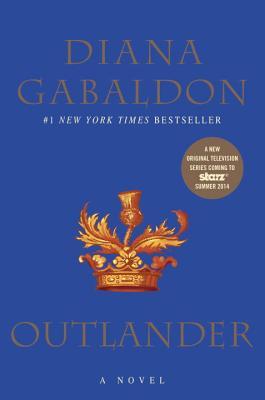
Top 20 Books I Read in 2017

My friend Natalie asked me to create a top ten list of the books I read in 2017. Of course, I have more than ten. So to celebrate this plethora of riches, I present to you my favourite reads of 2017.

Historical Fiction


Very different books. Both set in Scotland. There may be a few more Scottish titles on this list. I've been hypnotized by the Edinburgh Book Festival.

I had intended to add book covers and links to all of the books below. But then I'll never get this posted and it's already February. Here goes!

Young Adult

Rodent by Lisa J. Lawrence
Fifteen Lanes by S.J. Laidlaw

Both titles were nominated for the White Pine 2017 awards. Please keep in mind that I'm only listing books which I actually read in 2017. There are a couple of other White Pine 2017 titles that I loved, but I read them in 2016.

Education
Launch: Using Design Thinking to Boost Creativity and Bring Out the Maker in Every Student by John Spencer

Enjoyed meeting up with my Tweeps old and new in the #LaunchBookChat this year!

International
Exit West by Mohsin Hamid
Goblin by Ever Dundas

Essays
Nasty Women by 404 Ink
One Day We'll All Be Dead and None of This Will Matter by Scaachi Koul

Nasty Women led the revolution in the year of the great shake up of #MeToo #BlackLivesMatter and #OscarsSoWhite.

Scaachi Koul's acerbic essays hit the funny bone. Clever book jacket design, too.

Non-Fiction
Sapiens: A Brief History of Humankind by Yuval Noah Harari
Mind blown
The Fact of a Body by Alexandria Marzano-Lesnevich
Finely peeling away the layers of secrets
The Vanishing Man: In Pursuit of Valazquez by Laura Cumming
Winner of the 2017 James Tait Black Prize for NonFiction, a stunning tale of how art can consume us.

Picture Books
The Tale of Tam Linn by Lari Don
Scottish fairytale. A favourite of my niece's.
Journey by Aaron Becker
Only illustrations. Beautiful ones, at that. Great way for pre-literate or early literate children to tell stories.

Literary Fiction
What Belongs to You by Garth Greenwell
Nominated for the 2017 James Tait Black Prize for Fiction
The Last Neanderthal by Claire Cameron
Made me mourn for the extinction of the neanderthal. I want a lip like Girl's. Nominated for the 2017 Rogers Writers’ Trust Fiction Prize.

Mystery
All the Devils by Neil Broadfoot
Broadfoot's writing keeps getting better. Novel is set in Edinburgh. Scotland, yet again!
Glass Houses by Louise Penny
A perennial favourite - it's a good thing that Penny tends to publish a book a year!

Fantasy
A Darker Shade of Magic by V.E. Schwab
This book was partly written in Edinburgh. And it shows.

Short Stories
The 2017 Short Story Advent Calendar by Hingston & Olsen Publishing
Forget about the chocolate - open a new short story every morning leading up to Christmas. Great being introduced to new writers and chatting with other readers about the tales on Twitter. #ssac2017

Poetry
I tend to read bit and bites of poetry, but what got me hooked on poetry this year like never before was the FutureLearn course, "Literature and Mental Health". Highly recommended.

Other Recommendations
This list from Kirsty Logan who read 220 books. Quite a diverse range of books that puts my list to shame. Enjoy!
http://www.kirstylogan.com/best-books-of-2017/


Wednesday, 3 January 2018

Autumn by Ali Smith

AutumnAutumn by Ali Smith
My rating: 5 of 5 stars  View all my reviews
Read Autumn the way you would a collage painting: What’s the big picture? What’s in the details? How does the story all hang together, and what do we imagine happens next? Autumn is a painting made up of words, as Daniel shows Elisabeth when he asks her to close her eyes and imagine as he describes a collage by Pauline Boty. Elisabeth is able to recognize the painting when she actually sees it.

Sixties icons play a central role in the novel: Pauline Boty, as well as Christine Keeler (who was the subject of one of Boty’s paintings), serve as totems for us to examine our present time. In an article by Ali Smith herself, she describes the work of Pauline Boty as dropping “us head-first into a dream, and when the dream turns into a nightmare she slaps it in the face, wakes up into what’s now a multilayered narrative of dreamworld and mundanity” [1]. Quite often in the book, when things seem to be quite grim for Elisabeth (and the world), Daniel shows how art can lift you out of the darkness.

Ali Smith, writer, signing books at the Edinburgh International Book Festival. By Tim Duncan. From Wikimedia Commons.


Christine Keeler’s role seems to guide us to the question, “What happens culturally when something is built on a lie?” [2]. The fallout from Brexit is definitely in the book, from the comically absurd task of applying for a passport, the fences around common land, and the spray painting of “GO HOME” on people’s houses. Ali Smith uses fiction and painting to remind us “to read the world as a construct. And if you can read the world as a construct, you can ask questions of the construct and you can suggest ways to change the construct. You understand that things aren’t fixed” [2].

Initially, I thought about giving the book a four star rating because of its lack of resolution. But you have to stare at the novel, dissect it, make connections,  and do research. By God, did Smith do a lot of research - which is not immediately apparent, especially considering the speed with which this book was written and published: “Maybe an accelerated news cycle requires accelerated art” [2].

We live in the era that comes after Rule Britannia (political empire) and Cool Britannia (the resurgence of the cultural empire). Does Europe and the rest of the world ask what happens Post-Britannia? What has the empire stood for, for us? Smith looks to the art of Pauline Boty and her final testament: A “message of undying hope, of solidarity with the oppressed, and of certainty about the future that gave all us us more than courage. Determination” [1].

Works considered while writing this wee review:
[1] Ali Smith on the prime of pop artist Pauline Boty

Wednesday, 9 November 2016

Reading List for a Trumpish America


Some context, after the election. Five new books and one oldie, but a goodie. 


“Offred is a Handmaid in the Republic of Gilead, once the United States of America” (back cover).


“America is on the verge of anarchy. Survival is all that matters now” (front cover).


“Trump, the silver spoon-fed child who, as a second grader, punched his music teacher in the eye, aspired ‘to be the toughest kid in the neighborhood’” (5).


“The public utterances of almost every populist politician today include the refrain ‘Take back control’” (31).


“The birthers cut straight to the chase and argued that Obama’s birth certificate was phony and that he was not born in America, a claim amplified by billionaire political huckster...Donald Trump” (135).


“During World War II, America’s fledgling aeronautics industry hired black female mathematicians to fill a labor shortage. These ‘human computers’ stayed on to work to NASA and made sure America won the Space Race. They fought for their country’s future, and for their share of the American dream. This is their untold story” (front cover).

Sunday, 16 October 2016

Girl Mans Up

Girl Mans UpGirl Mans Up by M-E Girard
My rating: 5 of 5 stars

Wow! What a great way to spend a weekend. M-E Girard's Girl Mans Up first impressed me with its universalism on how we all have to deal with the vagaries of love. The book deals with gender, sexuality, family drama, high school bullies, peer pressure, friendship, videogames! and grabbing your own power.

The protagonist, Pen, is a girl who is mistaken for a boy, but defies categorization. When someone asks her if she is a gay girl, Pen thinks: "I don't think of myself as being gay, because that word sounds like it belongs to some guy. Lesbian makes me think of some forty-year-old woman. And queer feels like it can mean anything" (65). The one thing that Pen is adamant about is that she is a girl.

Out of the two female relationships Pen has in the book, I find her friendship with Olivia the most interesting. There's more growth between those characters, maybe because there is much more at stake. The love interest, Blake, is definitely kick-ass, but restricted in her role as the object of desire. That said, their scenes together are well written: not graphic, but plenty to activate the imagination.

The guys in the book don't come off well. The opening chapters of Pen hanging out with the boys have a greasy feel. Maybe those guys just need to Woman Up.

Except Johnny, of course. I love Johnny. We all need a big brother like Johnny.

View all my reviews

Saturday, 1 October 2016

Book Signing

At the Edinburgh Book Festival, I attended an interview with a former pro athlete who had written a book. He was very animated and outgoing during the talk - even leaping up to kiss a woman at the back of the auditorium.


I sometimes dread asking an author to sign my book because it's hard for me to make small talk with someone who doesn't mind spending hours alone scribbling. Based on his personality during the interview, I thought that this elite athlete would be a chatterbox.


But as the long line coiled out the door and around the gardens, the author looked petrified as the queue never seemed to end. When I got to him, I tried to be chirpy and upbeat, but the work of performance had worn him down.

An introvert. Like me.

Tuesday, 30 September 2014

Bad Feminist: Essays

Bad Feminist: EssaysBad Feminist: Essays by Roxane Gay
My rating: 4 of 5 stars

I quickly devoured Bad Feminist. Even though Roxanne Gay cites some academic heavyweights, the text is utterly readable. These essays are more personal and political than theoretical, and my favourite topics include:

• the question of privilege
• race
• gender: featuring Judith Butler & Helene Cixous
• humour
• pop culture: Loved her essay about the Hunger Games, “What We Hunger For”
• fairy tales
• misogyny –topics as diverse as Junot Diaz’s “This is How You Lose Her” and Robin Thicke’s “Blurred Lines”

The book won me over at the beginning. When talking about advising and helping students, Gay reports that the students would “generally say, ‘Don’t tell anyone I came to see you.’ It wasn’t that they were embarrassed to get help, most of the time. They were embarrassed to be seen putting effort into their education, to be seen caring” (9-10). A couple of years ago, we had a documentary filmed at our school called, Colour Me.  It was about race and education. The students reported that doing well in school wasn’t considered the “black” thing to do. Wow. Together with Roxanne Gay’s observations, I am stunned.


Sometimes I was bothered about the "shape" of the essays. In some cases, I anticipated that I was being led somewhere and found myself left hanging at the end of the text. Maybe a re-read is necessary.

Some mature content and language.

View all my reviews

Video credit:
Barsoum, Sherien. "Colour Me Documentary Film Official Trailer."YouTube. YouTube, 13 May 2011. Web. 30 Sept. 2014. <https://www.youtube.com/watch?v=FZzesdSPdeI>.

Tuesday, 8 July 2014

Why We Still Teach Language

"In the previous, exclusively oral culture, language controlled people and their behaviour; with writing, the reverse became true. Societies that could read and write achieved a degree of control over language that allowed them to gain a new kind of mastery over their destinies" (De Kerckhove, 194).


Quote from:
De Kerckhove, Derrick, The Skin of Culture: Investigating the New Electronic Reality. Toronto: 
     Somerville House Publishing, 1995. Print.

Image posted on Facebook by @asobec, July 5, 2014.

Saturday, 8 February 2014

Close Reading in the Digital Age

Is close reading becoming a lost art?

I hope not, but I find that our digital tools are often a distraction and used more for entertainment than illumination. Next week at my school the distraction is being taken away from us--at least temporarily. Our computer network will be shut down for a week for an OS upgrade. There's no better time to reacquaint ourselves with the important skill of close reading. Of course, we won't give up our digital tools once the upgrade is complete. Below are some suggestions on how to use technology to enhance reading.

A Beautiful Classroom Poster on Close Reading provides teachers with a free, downloadable poster suggesting ways to help students become better close readers:


Actually Achieving Close Reading with Digital Tools shows ways to leverage screen capture and annotation tools to assist with close reading.

10 Strategies to Reach the 21st Century Reader examines how media design influences the modern reader. Skip to the end of the article to see how using media can enhance reading skills.


Thursday, 31 October 2013

Decoding Assignments for ESL Students

Every semester we hold a Project Complete program to allow students to catch up on their work before midterm report. I am asked to help ESL students who have fallen behind on their schoolwork. Why have they fallen behind? They don't understand what to do.

In split-level classes, it is difficult for teachers to address the needs of all learners. Students new to Canada and the English language need more one-on-one instruction and modified assignments.

Here's an example of how I helped an ESL A student complete a grade 9 geography task to create a brochure for a Canadian national park.

1. Chunk the assignment. The research was in three parts. I only asked the student to look at one part at a time.


2. Highlight key words. Reduce the text.


3. Use Google Translate and Google Images to decode vocabulary.


4. Next, we went on to the Parks Canada website. I had to guide the student on how to use the features and navigation tools. Make the student read short pieces of text. Don't let them depend on you to do all the work. The one who does the work does the learning. Let them struggle with something they can handle.

5. Use "speak" functions for longer texts.


6. Print PDF fact sheets. Show which paragraph each answer is found in, otherwise the amount of text is overwhelming.


7. Still too much English? Ask student to highlight the words they DO know. For example, to complete the landform section, ask the student to highlight familiar vocabulary in the geography paragraph. Next, the teacher underlines two or three new and important words in pencil. Have the student look up the meaning of the words by using Google Images. Once he or she understands the word, the student can highlight it.


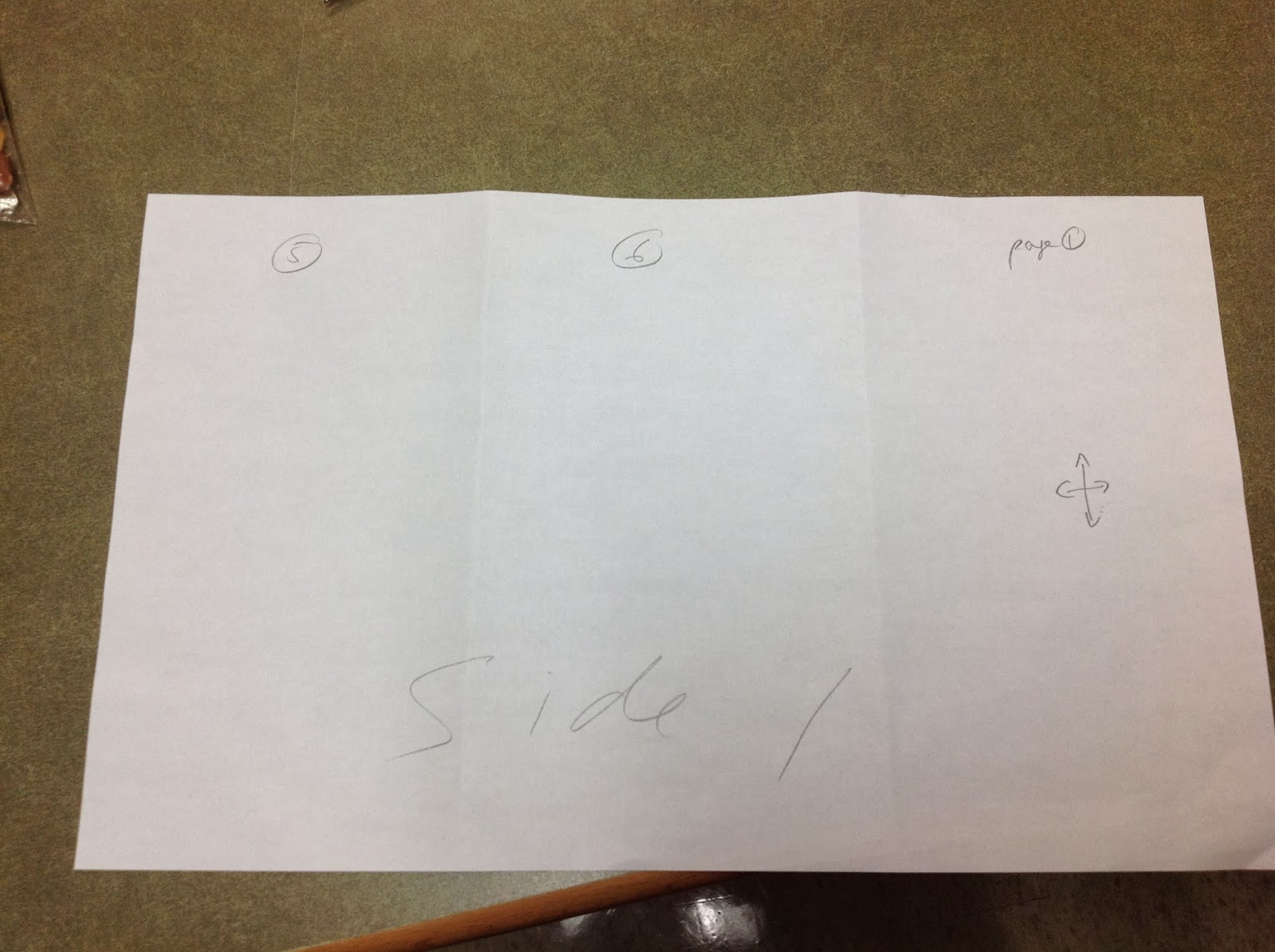
8. When the chart is complete, start transferring info to a brochure template on Publisher. Using Publisher or other computer programs will probably require further instruction. For example, you should show the student how the layout of a brochure works. Page 1 is on the same side as pages 5 and 6.


9. Print off a draft of his or her brochure.


10. Check against expectations. It is important that the student is involved in this process.


11. Edit with the student. Talk about why changes need to be made.


12. Student makes corrections and goes home happy once he or she has completed the task.

Note: This assignment took two days to complete. The next day, the student's teacher reported that the student wanted to try to complete tasks on his own even when she offered to help. He learned that he CAN do it!

Saturday, 26 October 2013

Googlers, Databasers & Bookies

"I'm so sick of students using Google!" a teacher said to me.

"How about letting them discover if it's the best way to find information for an assignment?" I replied.


In this instance, it was an English class of 30 that came in. I divided them up into three groups: Googlers, Databasers and Bookies. Each group had to find the three best essays in their allotted medium on Charlotte Perkins Gilman's "The Yellow Wallpaper". It is important to note, there was no assignment attached to this task. They were to spend two hours simply searching for great essays.


The class also given a Best Resources chart to fill out to record their progress, as well as three sticky notes. After they had filled out the chart, they were to reflect and record their observations on their resources on a sticky note and put their observations on a "+" "-" and "!" chart. What were the advantages of their resource? What were the disadvantages? What did they learn?

Some of the groups needed mini-lessons:
  • The Bookies on how to use the library catalogue and the Dewey Decimal system to locate a book.
  • The Databasers needed help accessing the databases and narrowing their focus.
  • The Googlers felt that they didn't need any help at all.
Which group finished first? Whenever I've done this task, it has alternated between the Databasers and the Bookies. It was interesting to observe that the Bookies always worked collaboratively and that each class concluded that the databases were the best place to look for information on this topic. Surprisingly (or not), the Googlers had the hardest time finding good resources. They were always the last group to finish because they did not know how to use the advanced search options in Google. The group got stuck retrieving commercial sites selling essays or university-level work from Google Scholar. I've suggested to students that they may enjoy learning how to become a Google Power Searcher... for free.

Students discovering which resources are the best by themselves...priceless.

(It is important to note that the point of this exercise is NOT to show that Google is bad. It is simply to find out which resource is the best place to find information on a given assignment. For example, I have had other results for students doing a science project.)


Image credits:

DR. SEUSS' THE CAT IN THE HAT (2003) - MYERS, MIKE; BRESLIN, SPENCER; FANNING, DAKOTA.Photography. Encyclopædia Britannica Image Quest. Web. 8 Oct 2013.http://quest.eb.com/images/144_1530573

Google Logo. Photography. Encyclopædia Britannica Image Quest. Web. 8 Oct 2013.http://quest.eb.com/images/158_2456205

Thursday, 24 October 2013

"Your Teacher Loves Wikipedia"

OK, this lesson isn't what you think.

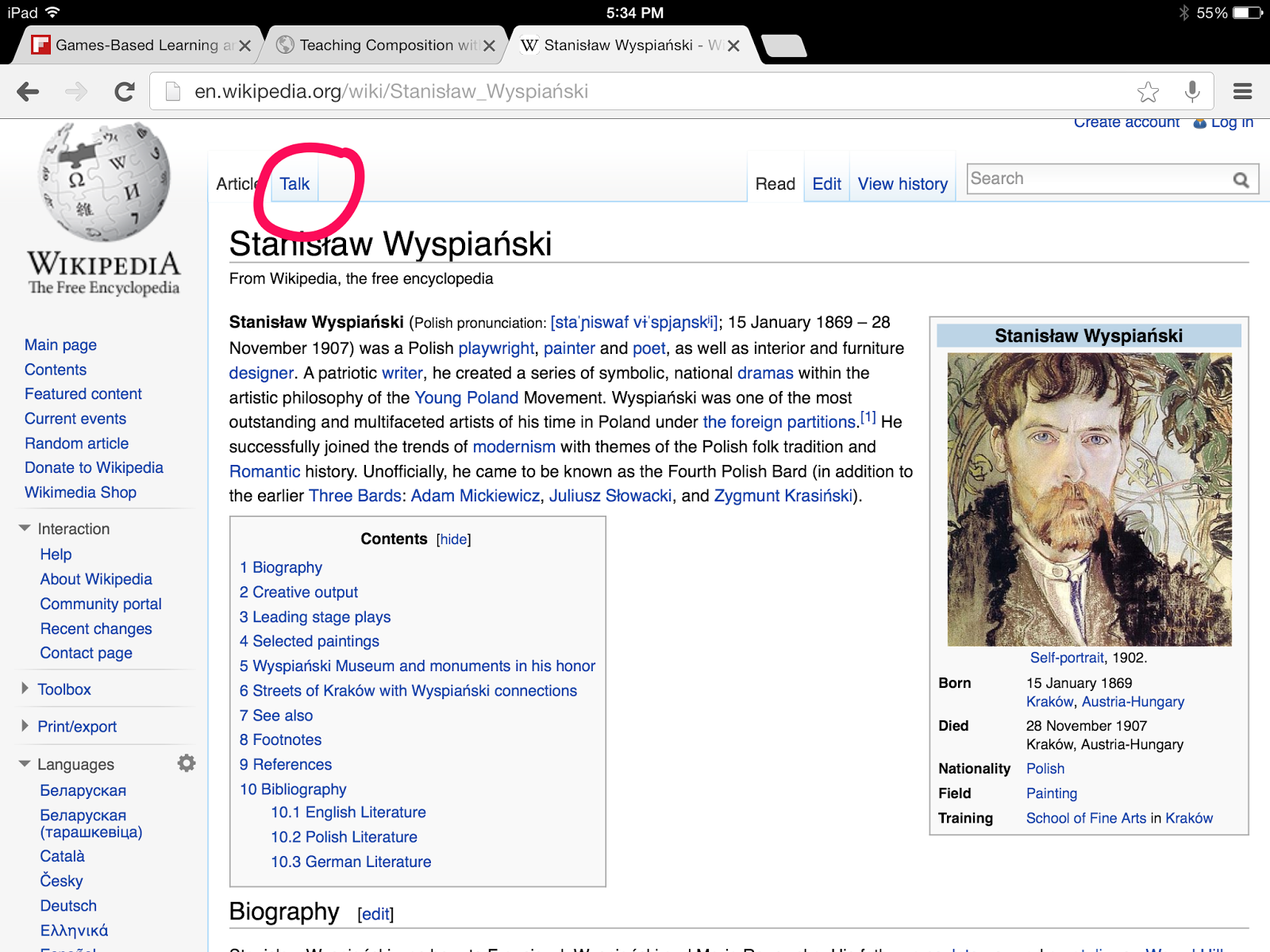
Anthropology students had to look for information on a social scientist, e.g., Richard Lee, Sigmund Freud, in order to write a CV for them.

I told them to use Google and Wikipedia to get their information. Both the students and the teacher were shocked.

Here's my justification:

Your Teacher Loves Wikipedia (Click on the heading for slideshow & notes)


But the assignment didn't stop there. The students then had to network in the role of the social scientist they had researched. Ultimately, they had to find which other social scientists they could work with.

At first, I thought this task was a lot of busy work for content that could be delivered more simply: That is, give them a few chapters to read and then categorize the scientists. Instead, their teachers thought this exercise would make the task more interesting for the students.

But here's where the surprise came in: Content isn't what the students are learning. Where the students struggled was picking out what was relevant for the CV. It became a reading and critical thinking exercise. These skills were what they were learning.

Students also learned - in one boy's words-: "The internet sucks." He found six different sources: three stated that his social scientist was kicked out of school; three said he left school because the school was shut down. Learning is more effective if students figure out this unreliability problem on their own.

The teacher saved the day by asking the student, "Do you need to include his elementary school years on his resume anyway?"


Sunday, 20 October 2013

Alice Munro Country

Travels through Munro Country: Bayfield, Wingham, Port Albert and Goderich. Inspired by "Where Alice Munro found her Stories".


Ceiling ornament


Shipwreck Chart of the Great Lakes


Tuesday, 8 October 2013

Employing the Easter Egg

The other day I was thinking about gamification -specifically, how to apply game elements to education - and I remembered how I "tricked" my nephew into reading. He was at the cusp of reading a few sentences independently, but he was stubborn. He did not want to try to sound out words on his own.


I devised an Easter egg hunt with a difference. Instead of simply hiding chocolate eggs around the house, I bought some hollow plastic eggs that opened. Inside, I put a clue to the location of the next egg. With each egg, I included a small dollar store trinket.

I thought my nephew would have been more interested in the prizes, but instead he demonstrated that he was motivated by something intrinsic instead. After he had found all of the eggs, he wanted to do the hunt all over again, with the clues only. There was something about finding the next piece to the puzzle that propelled him to keep on reading. He did not resist sounding out the words; in fact, he wanted to figure it out for himself.

This game continued for many years. Eventually, the clues turned into riddles to get him to predict and think more critically. Now a teen, he wouldn't say no if I offered to do an Easter egg hunt again.

Image credits:
Coloured Easter Eggs. Photography. Encyclopædia Britannica Image Quest. Web. 4 Oct 2013.http://quest.eb.com/images/156_2394411

Thursday, 12 September 2013

BYOD & Appy Hour

"I hate reading, making presentations, etc."


During the first week, we've been exploring what it means to be a BYOD school. One class told me where they struggle with their learning. My response each time was: "There's an app for that."


For example, I had a group of girls who were afraid of making presentations. Together, they learned how to use:
instead of making stand-up-in-front-of-the-class presentations. Other possible tools include:

For additional ideas, check out: "Six Visual Learning Tools".

There was a gaggle of boys who said that they hated reading. I asked them: "Do you like being read to?" They said: "YES!" They learned that if they changed their iPad/iPod/iPhone's accessibility settings, they could get their device to read to them:

First, go to "Settings" and select "General". Click on "Accessibility".


Next, go to "Speak Selection".


Turn on "Speak Selection". You can choose a dialects (accent) and adjust the speaking rate (speed).


Appy Hour

Students were given a chance to explore and experiment with these (and other) apps, features, and online tools. We were amazed at how focused they were on the task. We were equally impressed with their mini-presentations afterwards: They shared what they had discovered with their classmates. In fact, each student became the "expert" for other students to go to to learn about his or her particular tool.

Cool.

Image credits:

Class Presentation. Photography. Encyclopædia Britannica Image Quest. Web. 8 Sep 2013.http://quest.eb.com/images/139_1918369

Two Apple IPad 2 Tablet Computers Desktop And App Store On Their Displays. Photo. Encyclopædia Britannica Image Quest. Web. 8 Sep 2013.http://quest.eb.com/images/167_4036507

Sunday, 8 September 2013

Flipping the Library

Finding a Book

Since the library was booked by another department this week, I was able to show students how to find a book in the library without being in the library.


It's my J-O-B!

My J-O-B

First week back: I used this Flocabulary video to introduce my role in the school:


Original post: http://www.flocabulary.com/ode-to-librarians/

Friday, 2 August 2013

Groupwork? Meh.


"I am a horse for a single harness, not cut out for tandem or teamwork...for well I know that in order to attain any definite goal, it is imperative that one person do the thinking and commanding" (Cain 71). -Albert Einstein

"Work alone" (Cain 73). -Steve Wozniak


"Society is itself an education in the extrovert values, and rarely has there been a society that has preached them so hard. No man is an island, but how John Donne would writhe to hear how often and for what reason, the thought is so tiresomely repeated" (Cain 34). - William Whyte


"[I]nsight occurs when we balance direct engagement in a task with a kind of detached insouciance...[T]he left hemisphere of the brain tries to seek answers in the obvious places...,but sooner than later tires of the problem if it is at all difficult. When one gets away from direct immersion in a problem, the right hemisphere can still be, so to speak, working on the problem in subconscious ways. At some point, and in ways that are not easily traceable, the 'answer' seems to come out of the blue and in surprisingly complete form" (Fullan 26).

Quotes from
Cain, Susan. Quiet: the power of introverts in a world that can't stop talking. New York: Crown Publishers, 2012. Print.

Fullan, Michael. Stratosphere: integrating technology, pedagogy, and change knowledge. Don Mills, Ont.: Pearson, 2013. Print.

Image credits
A Woman Reads In Solitude On A Quiet Beach Next To Turquoise Water.. Photography. Encyclopædia Britannica Image Quest. Web. 1 Aug 2013.http://quest.eb.com/images/137_3162550

Brain. Photography. Encyclopædia Britannica Image Quest. Web. 12 Sep 2013.http://quest.eb.com/images/132_1289951

The Thinker. Photograph. Encyclopædia Britannica Image Quest. Web. 1 Aug 2013.http://quest.eb.com/images/139_1900093

Saturday, 15 September 2012

The Value of Literature Now Supported by MRI Imaging

"In an innovative interdisciplinary study, neurobiological experts, radiologists and humanities scholars are working together to explore the relationship between reading, attention and distraction – by reading Jane Austen."

Read more at: http://medicalxpress.com/news/2012-09-literature-mri-imaging.html#jCp